MAY 2026
Off-leash survey data referenced below is from Seattle Parks & Recreation's (SPR) 2016 owner survey, published in the 2017 People, Dogs and Parks Strategic Plan. That decade-old behavioral survey is the most recent public version; the 39% figure needs a current replacement. The "~1,100 Find-It-Fix-It nuisance-dog reports" figure is a secondary citation; a public records request (PRR) to Seattle Public Utilities (SPU) for exact annual counts has been filed and is awaiting response. Corrections and better primary sources are welcome — see the overview.
11.7%
Part II · Access

99% of Seattleites live within a 10-minute walk of a park. 11.7% live within a 10-minute walk of one where dogs are legal.

11.7% of Seattleites are within a 10-minute walk of a legal off-leash area (OLA). 76.6% are within SPR's published 2.5-mile OLA standard. This report measures the gap between "a park" and "a park where dogs are legal."

10-min walk to any park
99%
10-min network walk to an OLA
11.7%
Seattle residents, osmnx network + 2020 Census block groups. src
Seattle's dog-park density
1.82
Dog parks per 100K residents — TPL 2025, below every West Coast peer.
Part One
The walkability paradox.

Seattle ranks among the top U.S. cities for park access: 99% of residents live within a 10-minute walk of a park, per TPL's 2025 rankings. Measured the same way, the off-leash system covers 11.7% of residents. This section quantifies that difference across the 14 existing OLAs.

Finding 01Any park vs. a legally usable park.

Trust for Public Land's access metric uses a half-mile walkshed — the distance most people will walk before driving. By that measure, 99% of Seattle residents live within a 10-minute walk of a park. Applying the same metric to Seattle's off-leash areas produces a substantially smaller number.

Share of Seattle within a 10-minute walk
All three bars are population coverage — share of Seattle residents within the specified walk of the amenity. TPL's 99% for any park is their published figure. The two OLA bars are computed on this site: an osmnx network walkshed around every OLA (compute_walkshed.py) intersected with 2020 Census block-group population (population_coverage.py), area-weighted.
Source: TPL 2025 ParkScore Seattle (all-parks access, 99%) · OLA network walksheds computed via scripts/compute_walkshed.py (osmnx + Seattle OpenStreetMap walk network, 110,383 nodes · 305,582 edges, projected to UTM 10N) · population overlay via scripts/population_coverage.py against 2020 Census Decennial P1 block-group population · output in data/walkshed/population_coverage.csv · methodology in METHODOLOGY.md
Observation

The 10-minute-walk standard — used by TPL, NRPA, the 10-Minute Walk Campaign, and SPR when citing all-park access — yields 11.7% for OLAs. SPR's OLA-specific standard is 2.5 miles, which corresponds to roughly a 50-minute walk one way and covers 76.6% of residents. Applying the same 10-minute standard to both, 86,207 of Seattle's 737,559 residents (2020 Census) have a legal off-leash area within a 10-minute walk.

Finding 02Mapping the OLA gap.

The map shows Seattle's 14 existing off-leash areas with their half-mile walking-distance areas, the two under construction for fall 2026, and four sites in longer-term planning. These walk areas follow Seattle's pedestrian street network and stop at barriers — I-5, the Ship Canal, steep terrain — that a straight-line circle would cross.

Seattle off-leash areas, with half-mile walksheds
Half-mile network walking-distance areas along Seattle's pedestrian street network. Planned and in-design sites (walk area not yet computed) are shown as dashed straight-line half-mile circles and labeled as placeholders.
Observation

Even after the two fall-2026 OLAs open and all four planned sites are built, coverage remains uneven. The southeast quadrant (Rainier Valley, Beacon Hill south of Jose Rizal, Othello) gains access. Central and north neighborhoods (Ravenna, Wallingford, Green Lake, Phinney, Maple Leaf) remain largely uncovered. The nearest legal OLA for most of Queen Anne and Magnolia is Kinnear (0.124 acres); see the case study below.

Finding 02bWhere citations happen vs. where walkshed reaches.

If off-leash citations concentrate where OLAs aren't, the pattern should be visible in Animal Control's enforcement data. Here is the overlay.

Citations outside any OLA 0.5-mi walkshed
73.4%
3,631 of the 4,948 placed citations (park-named + geocoded street addresses)
Citations inside an OLA walkshed
26.6%
1,317 citations (1,210 park-named + 107 geocoded street addresses) — concentrated at the large OLA host parks: Magnuson (367), Woodland (291), Golden Gardens (227), Genesee (152), Westcrest (122), where citations fall on the non-OLA portions.

Of 37 uniquely identified parks in the citation data, 26 sit outside any OLA's 10-minute walkshed and 11 sit inside. Most of the inside parks are themselves OLA host parks — Magnuson (367 citations), Woodland (291), Golden Gardens (227), Genesee (152), Westcrest (122) lead — where the citations fall on the non-OLA portions (athletic fields, shorelines, wooded sections).

Two passes, same direction. Park-named only: 71.9% outside (3,089 of 4,299). Combined with 649 street-address citations geocoded via the Census Bureau batch geocoder with Nominatim fallback (464 of 489 unique addresses matched, 94.9%): 73.4% outside (3,631 of 4,948). Reproducible end-to-end via citation_walkshed_analysis.py + geocode_street_addresses.py.

Access × enforcement, one map
The 14 existing OLAs' 0.5-mi network walksheds are shaded green. Citation hotspots are bubbles (radius scales with citation count, 2014–2026). Orange bubbles are citation hotspots outside any OLA walkshed; amber bubbles are OLA host parks where citations occur on non-OLA portions.
0.5-mi OLA walkshed (network) OLA location Citation hotspot — no OLA Citation hotspot — at an OLA host park
Sources: walkshed polygons from scripts/compute_walkshed.py via data/walkshed/ola_isochrones.geojson · citation locations from data/enforcement-citations.csv (PRRs C049204 + C263949) aggregated by canonical park name · park coordinates from data/park-coordinates.csv · tiles: CARTO / OpenStreetMap
Observation

Citation hotspots cluster outside OLA walksheds: Capitol Hill (outside Plymouth Pillars), Queen Anne (outside Kinnear), Wallingford / Maple Leaf / Ravenna (north Seattle gap), Lincoln Park (3.4 mi from Westcrest). The observed concentration is consistent with walkshed absence, but citation records cannot distinguish violation rates from patrol targeting — they record where citations were issued, not where off-leash use is highest.

Method: each citation location is tested for whether it falls inside the merged 0.5-mile walk-distance areas (a point-in-polygon test against the network isochrones). Citation source: data/enforcement-citations.csv (PRRs C049204 + C263949). Isochrones: data/walkshed/ola_isochrones.geojson. 114 blank-location rows excluded. Aggregated output: citation-rate-by-walkshed-status.csv.

Finding 02cSeattle's OLAs and TPL's park-priority tiers.

One more check on placement: overlay the 14 OLAs on an independent map of where new parks would help most. Trust for Public Land maintains exactly that map.

What TPL's Park Priority Index is. For every Seattle Census block group, TPL ParkServe publishes a 1–5 composite score combining low-income density, density of people of color, health indicators (CDC PLACES), and heat/environment stress. A block group scoring 5 is where a new park would have the biggest equity and public-health impact; a 1 is already well-served on those dimensions. Seattle spans 606 block groups across the full range. The index is not a measure of existing park coverage and does not mention dogs.

The cross-tab. Sort each block group into four priority bands (1–2, 2–3, 3–4, 4–5), then compute the share of each band that intersects the union of the 14 OLAs' half-mile walksheds.

Share of Seattle block groups within a 10-min walk of an OLA, by TPL priority tier
606 block groups grouped by TPL's 1–5 priority score (higher = more acute need for new parks, combining income, race, health, heat stress). Bars show the share of block groups in each tier that fall inside the union of OLA walksheds.
Source: TPL ParkServe 2025 priority-area shapefile, filtered to Seattle (PlaceID 5363000, 606 block groups) · cross-tabbed against data/walkshed/ola_isochrones.geojson via scripts/build_tpl_overlay.py · output in data/tpl-parkserve/ola-walkshed-by-tpl-priority-tier.csv
Observation

The top-priority tier (4–5) has the highest OLA coverage at 43.7% — Magnuson, Westcrest, Dr. Jose Rizal, and Blue Dog Pond all sit in high-priority equity areas. The middle tier (2–3) has the lowest coverage at 14.5%. The enforcement pattern in Finding 02b shows citation hotspots concentrated in neighborhoods that fall in that middle tier (Queen Anne, Wallingford, Maple Leaf, Ravenna) and lack a nearby OLA.

Finding 02dOLA acreage vs. licensed-dog population, by ZIP.

Findings 01–02c measure geographic access. This one asks whether OLA acreage inside each ZIP is proportional to the number of dogs registered there. If it were, the per-ZIP ratio would be roughly constant.

What the data is. Seattle Animal Shelter publishes every active pet license on Seattle Open Data. Filtered to species = Dog and joined on ZIP, the April 1 2026 snapshot has 26,652 active dog licenses across 138 ZIPs, of which 32 are inside or adjacent to Seattle. Each ZIP's dog count is joined to the OLA acreage physically inside that ZIP (from data/seattle-olas.csv, point-in-polygon against seattleio/seattle-boundaries-data).

Fair-share baseline. If Seattle's 30.7 OLA acres were distributed in proportion to licensed dogs, each ZIP's fair share would be its dog count times the citywide ratio (~54.7 sq ft of OLA per dog, or 1 acre per ~796 dogs). Actual minus fair share gives the deficit (negative) or surplus (positive).

OLA acreage above or below fair-share baseline, by ZIP
Seattle-proper ZIPs only. Orange bars are under fair share; sage bars are over. Labels use neighborhood name with ZIP in parentheses — * marks ZIPs that span multiple commonly-distinguished neighborhoods; marks ZIPs that extend beyond Seattle city limits (excluded).
Source: Seattle Pet Licenses (April 1 2026 snapshot) · ZIP polygons from seattleio/seattle-boundaries-data · OLA acreage from data/seattle-olas.csv · join via scripts/analyze_pet_licenses.py · output at docs/data/seattle-zips/dogs-and-olas-by-zip.csv
Observation

The two largest deficits are South Lake Union / Uptown (98109) and Queen Anne (98119): each has roughly 850 licensed dogs and a single OLA of about one-tenth of an acre. The next three (U District / Laurelhurst, Madison Park / Montlake, Capitol Hill / Central District) have zero OLA acreage inside the ZIP. Four ZIPs sit above fair share — Westcrest (+7.3 ac), Magnuson (+5.7 ac), Dr. Jose Rizal + Blue Dog Pond (+4.3 ac), Genesee (+0.8 ac). Nearly every other Seattle ZIP is below fair share.

The same data drawn geographically. Darker navy = more licensed dogs in that ZIP; orange polygons are the union of OLA walksheds. The gaps — high-density navy without orange — are the under-served areas.

Seattle: licensed-dog density × OLA walksheds
ZIP polygons shaded by licensed-dog count. Orange polygons are the 0.5-mile network walksheds around each OLA.
High dog density (2,000+ licenses) Medium Low 0.5-mi OLA walkshed
Same sources as the deficit chart above.

Two adjacent-but-distinct neighborhoods carry the city's highest dogs-per-OLA-acre ratios.

South Lake Union · 98109
7,876
licensed dogs per OLA acre in SLU / Uptown — highest ratio in Seattle.

827 licensed dogs. Denny Park's OLA: 0.105 acres — 4,574 sq ft, roughly one basketball court for the neighborhood.

Queen Anne · 98119
7,016
licensed dogs per OLA acre in Queen Anne — second-highest ratio in Seattle.

870 licensed dogs. Kinnear OLA: 0.124 acres — 5,401 sq ft, about one basketball court for the neighborhood.

On neighborhood labels and ZIPs. ZIP codes are the finest geography the Pet Licenses dataset provides, but they don't map cleanly to named neighborhoods. Most Seattle ZIPs span two to five recognizable neighborhoods (98103: Fremont, Wallingford, Green Lake, Phinney Ridge, south Greenwood; 98122: Capitol Hill + Central District). Labels here lead with a primary neighborhood name and cite the ZIP for precision. A few ZIPs (98133, 98155, 98177, 98178, 98146, 98168) extend past Seattle's city line; those are excluded from the deficit chart because OLA acreage is Seattle-only. Licensed-dog counts are floors — compliance estimates put the actual dog population several times higher.

Part Two
Acreage — not just count.

"14 OLAs" is the headline count. Of those 14, half are under one acre and three are under a quarter-acre. The three largest — Magnuson, Westcrest, Dr. Jose Rizal — hold roughly three-quarters of Seattle's total OLA acreage.

Finding 03How small is small?

The median Seattle OLA is under one acre. The two smallest (Denny at 0.105 ac and Kinnear at 0.124 ac) are roughly the footprint of a basketball court each. Portland's smallest fenced OLA is larger than Seattle's third-smallest.

Seattle OLA acreage, ranked
Acreage estimates compiled from SPR site pages, the Seattle OLA Expansion Study, and COLA biennial reports. Values vary ±10% between sources; where ranges exist, midpoints are used.
Observation

The top four OLAs (Magnuson, Westcrest, Dr. Jose Rizal, Genesee) hold ~79% of Seattle's ~31 total OLA acres. The bottom seven (Lower Woodland, I-5 Colonnade, Magnolia Manor, Regrade, Plymouth Pillars, Kinnear, Denny) collectively hold under 10%.

Finding 03bSpace per resident, space per dog.

Divide Seattle's total parkland by its human population, and divide the OLA footprint by the dog population. The resulting footprints, drawn at the same scale:

Drawn to scale · 1 px = ~0.4 sq ft
Every Seattle resident's share of parkland
355 sq ft
About the footprint of a small studio apartment
Every Seattle dog's share of OLA
5.4 sq ft
About the footprint of a doormat

A Seattle resident has roughly 66× more parkland per person than a Seattle dog has dedicated off-leash space per dog. At the conservative 150,000-dog floor (Seattle Humane's lower estimate), the ratio is 40×.

On the comparison Dogs are allowed in Seattle parks — on leash. The comparison here is specifically off-leash space. Seattle has 6,662 acres of parkland where off-leash dogs are either prohibited or subject to citation. The 30.7 designated OLA acres — 12 fully fenced sites, plus Magnuson and I-5 Colonnade as partial-fenced — are the legal exception. 99.5% of Seattle's parkland is off-limits to off-leash dogs; that is what the boxes are drawing.
Math: 6,662 ac total parkland (TPL 2025 ParkScore Seattle) ÷ 816,600 residents (WA OFM 2025) = 0.00816 ac/resident = 355 sq ft. 30.7 ac OLA total (seattle-olas.csv) ÷ 248,858 AVMA-estimated dogs (illegal-use-indicators.csv) = 5.37 sq ft/dog. Ratio 355/5.37 = 66.1.

Amenities: lighting, water, small-dog areas

Amenity inventory for Seattle's 14 OLAs. Citizens for Off-Leash Areas (COLA) surveyed OLA users and published the amenity breakdown; numbers are cross-checked against current SPR OLA pages (April 2026).

Have lighting
2 of 14
Westcrest and Denny per SPR individual OLA pages. Fall/winter evenings after work are unusable at the other 12.
Have water access
9 of 14
Drinking fountain, doggie fountain, or hose listed by SPR at Westcrest, Genesee, I-5 Colonnade, Blue Dog Pond, Dr. Jose Rizal, Denny, Magnolia Manor, Regrade, Plymouth Pillars. Kinnear is not on that list.
Have small-dog areas
5 of 14
Magnuson, Westcrest, Genesee, Golden Gardens, Magnolia Manor per current SPR OLA pages.

Approximately 79% of Seattle's total OLA acreage is concentrated in four parks (Magnuson, Westcrest, Dr. Jose Rizal, Genesee). SPR's own survey work identifies the top reason non-OLA users give for avoiding OLAs as location inconvenience. The four most-frequented OLAs in SPR's tracking are Magnuson, Westcrest, Golden Gardens, and Woodland. The Kinnear case study below details one site's usage profile.

Source: COLA biennial report and user survey · amenity inventory cross-checked against SPR individual OLA pages · primary citations retained in sources/nextdoor-qa-playfield-2021.md

What "too small" means, quantified

Three independent authorities publish overlapping standards for the size of a functioning neighborhood dog park and the per-dog capacity a park of a given size can support.

AKC recommendation
≥ 1 acre
Minimum size with 4–6 ft fence, per AKC Establishing a Dog Park in Your Community.
Industry design consensus
1–5 acres
Community dog-park sizing, with 1 acre as the practical floor. Per Parks & Rec Business and municipal design guidelines (Ann Arbor, Fairfax County).
Per-dog capacity
75–100 sq ft
Recommended planning density at peak use. Below this, injury and behavioral-conflict risk rise. Dog Park Size Guide.

Applied to Seattle's 14 OLAs: seven of 14 are below the AKC 1-acre floor. Three are below 0.25 acre. Implied peak capacity at the 100 sq ft per-dog standard, for the smallest sites:

OLA Area (sq ft) Cap at 100 sq ft/dog Cap at 75 sq ft/dog Below AKC 1-ac min?
Denny Park4,5744661Yes — 0.105 ac
Kinnear5,4015472Yes — 0.124 ac
Plymouth Pillars8,71287116Yes — 0.20 ac
Regrade13,068131174Yes — 0.30 ac
Magnolia Manor20,909209279Yes — 0.48 ac
I-5 Colonnade21,780218290Yes — 0.50 ac
Lower Woodland32,670327436Yes — 0.75 ac
Golden Gardens43,560436581At floor — 1.0 ac
Northacres60,984610813No — 1.4 ac
Blue Dog Pond74,052741987No — 1.7 ac
Genesee117,6121,1761,568No — 2.7 ac
Dr. Jose Rizal174,2401,7422,323No — 4.0 ac
Westcrest365,9043,6594,879No — 8.4 ac
Magnuson392,0403,9205,227No — 9.0 ac
Observation

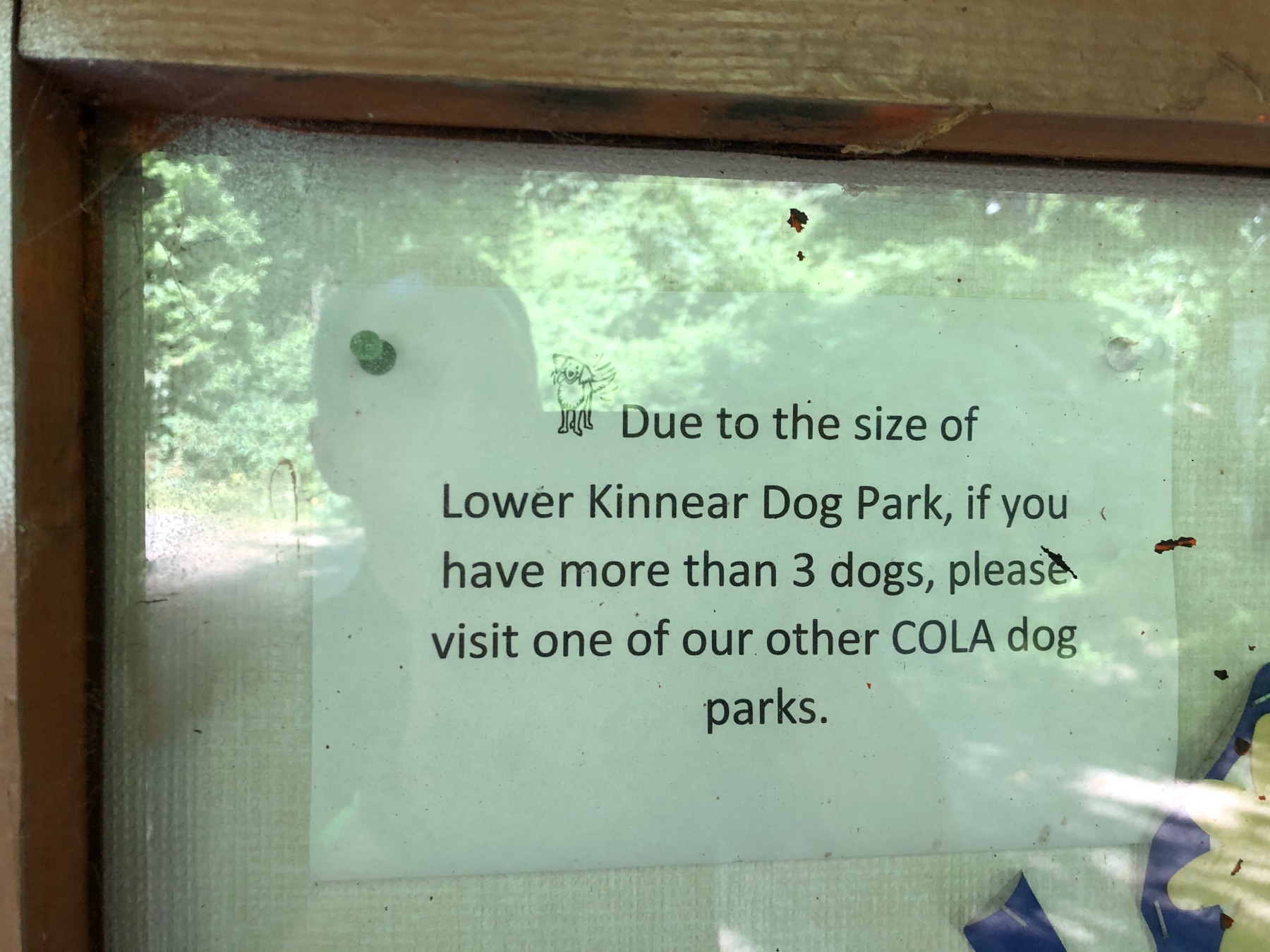
Kinnear's implied peak capacity is 54 dogs at the 100 sq ft standard and 72 dogs at the 75 sq ft floor. SPR signage at the park asks owners with more than 3 dogs to use another OLA. Kinnear is the only designated OLA within a 10-minute walk of most of Queen Anne.

Finding 04Peer-city acreage, with a methodology note.

Comparing total OLA acreage across cities is harder than comparing counts because cities define "off-leash" differently. Portland has 38 DOLAs (TPL 2025) but most are unfenced voice-control areas. San Francisco counts 42 dog-friendly sites including small Dog Play Areas (DPAs) inside larger parks. Vancouver BC counts 36 including time-restricted areas. Seattle counts only fully-fenced dedicated OLAs.

A best-effort comparison of OLA acreage per capita, with caveats inline:

City OLA count (methodology) Est. total OLA acres OLA acres per 10K residents Largest single OLA Median OLA size
Seattle, WA14 (all fenced)~310.389.0 (Magnuson)0.9
Portland, OR38 (most unfenced)~851.29~5 (Gabriel; fenced)1.3
San Francisco, CA42 (mix fenced/unfenced)~1201.3814 (Fort Funston, GGNRA)‡1.5
Vancouver, BC36 (mostly time-restricted)~1682.5440 (New Brighton)2.3
Austin, TX13 (mix)~680*6.63*293 (Walnut Creek Metro Park, voice-control natural area)*2.0

* Austin's "largest" entry (Walnut Creek Metropolitan Park, 293 ac voice-control natural area) is not a traditional fenced dog park; the unadjusted Austin total of ~680 ac (sometimes cited externally) reduces to ~80 ac on a fenced-comparable basis (the figure used here). Portland's ~85-ac total comes from PP&R's published DOLA inventory and includes unfenced voice-control sites; Portland's largest single fully-fenced site is Gabriel Park's ~5-ac DOLA, well below the totals shown for SF, Vancouver BC, or Austin's largest.
Fort Funston is GGNRA federal land, not SF Rec & Parks property; off-leash access there has been contested under the GGNRA Dog Management Plan. Listed here as the largest off-leash area SF dogs commonly use; SF's largest city-managed dog play area is closer to 4 ac. The per-capita counts still substantially exceed Seattle. Vancouver BC's 168-acre total (from its 2017 People, Parks & Dogs Strategy) reflects time-restricted shared-use areas on beaches and fields.

OLA acres per 10,000 residents — methodology-adjusted
Excludes outlier off-leash hiking areas (Thousand Acres OR, Red Bud Isle TX). Vancouver BC includes time-restricted beach/field access.
Observation

On per-capita OLA acreage, counting only fully-fenced sites in Seattle against each peer city's own definition, Seattle sits at the bottom of this five-city comparison. Vancouver BC has ~6.7× Seattle's per-capita acreage; San Francisco and Portland, ~3.4× and ~3.4×.

Part Three
Illegal off-leash use: what the data shows.

Two public datasets bear on the scale of illegal off-leash use: SPR's 2016 owner survey (self-reported) and Find-It-Fix-It nuisance-dog reports (~1,100 in 2024, secondary citation). A public records request for exact annual FIFI counts has been filed and is pending; this page will be updated when the data arrives. The off-leash ticket records have since arrived (PRR C263949) — citation-record analysis through April 2026 is on the Enforcement page; this section collects the survey and complaint numbers.

Finding 05What Seattle's own data says.

In 2016, as part of the research that became the People, Dogs and Parks Strategic Plan, SPR surveyed Seattle dog owners about compliance with leash laws. The results have not been prominent in SPR communications.

Owners off-leash in local parks
39%
Monthly or more frequently (SPR 2016 survey).
Owners off-leash on park trails
38%
Same survey, separate question.
Find-It-Fix-It nuisance-dog reports, 2024
~1,100
"Dog in a park" complaints filed via city app (secondary citation; PRR filed, awaiting response).
Off-leash tickets, Mar–Aug 2016
435
Seattle Animal Control issuance over 6 months.

Two of five dog owners in the 2016 survey reported illegal off-leashing in parks on a monthly-or-more basis — a self-reported figure, to a survey run by the enforcing agency. SPR's 2023 OLA Expansion Study frames expansion as a goal “to advance [the] goal of creating OLAs that are increasingly within walking distance of residents and allow SPR to fill in geographic gaps where neighborhoods lack access to an OLA.”

Find-It-Fix-It complaints about off-leash dogs in parks have risen year-over-year as Seattle's population has grown and the OLA count has remained flat.

Finding 06Factors associated with illegal off-leash use.

1. No legal option nearby.

About nine in ten Seattle residents are outside a 10-minute walk of an OLA (only 11.7% are within one). A 25-minute drive with a 70-pound dog is a higher friction cost than walking to the local park.

2. The legal option is small.

A 0.1-acre OLA (Kinnear, Denny) or 0.2-acre OLA (Regrade, Plymouth Pillars) has limited running room. Owners with high-energy dogs often choose a larger unauthorized space over a smaller authorized one.

3. Site-adjacent safety concerns.

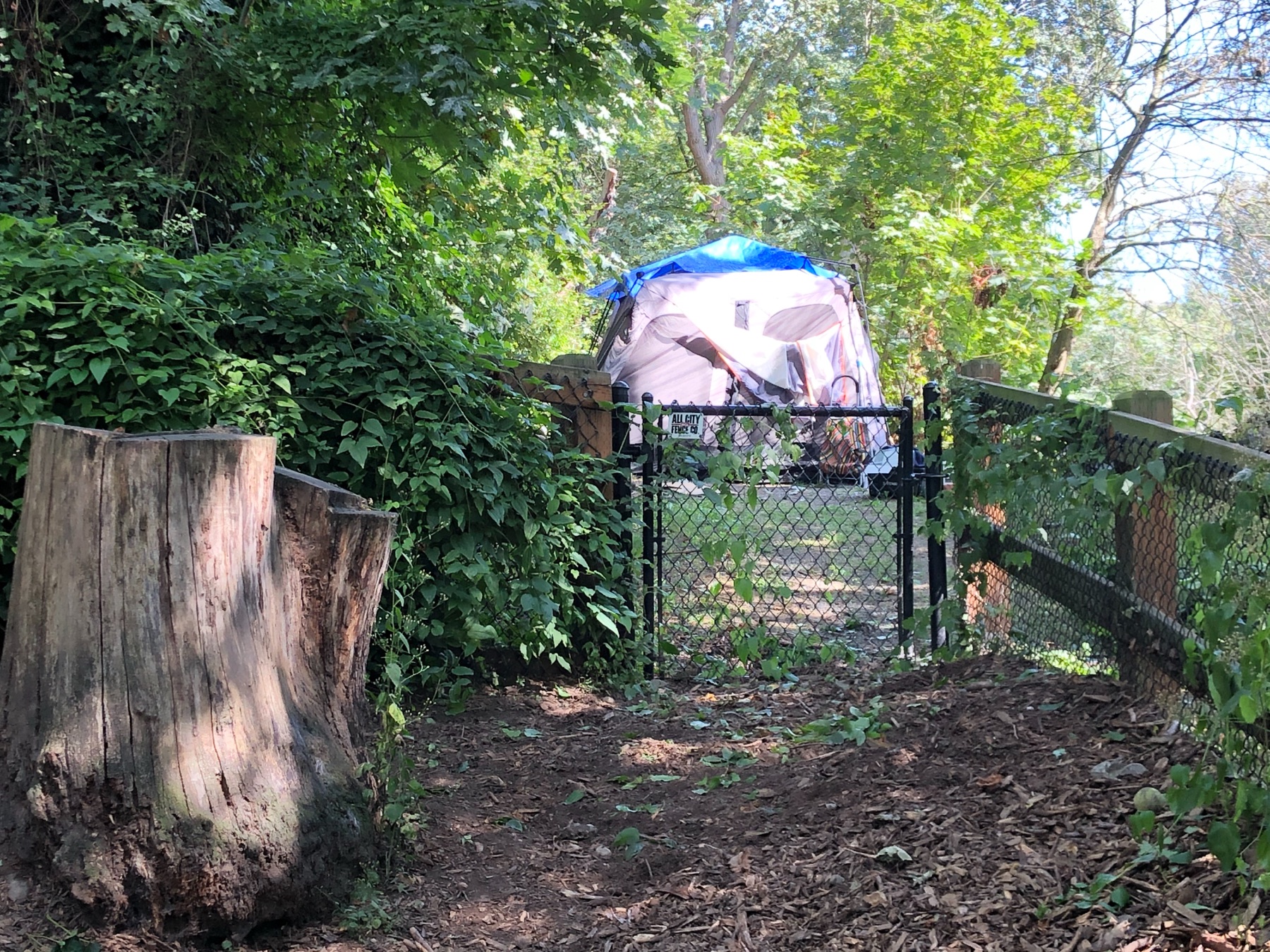
Several OLAs — among them Kinnear and Plymouth Pillars — sit adjacent to or are accessed through areas with chronic encampment and safety issues. The Kinnear case study below documents one 20-year record.

Net pattern.

Enforcement data (Finding 02b) shows citations concentrated in neighborhoods without a nearby OLA, not distributed evenly across the city. The pattern is consistent with a supply-driven explanation.

Case study · 20-year documented record

Kinnear Park.

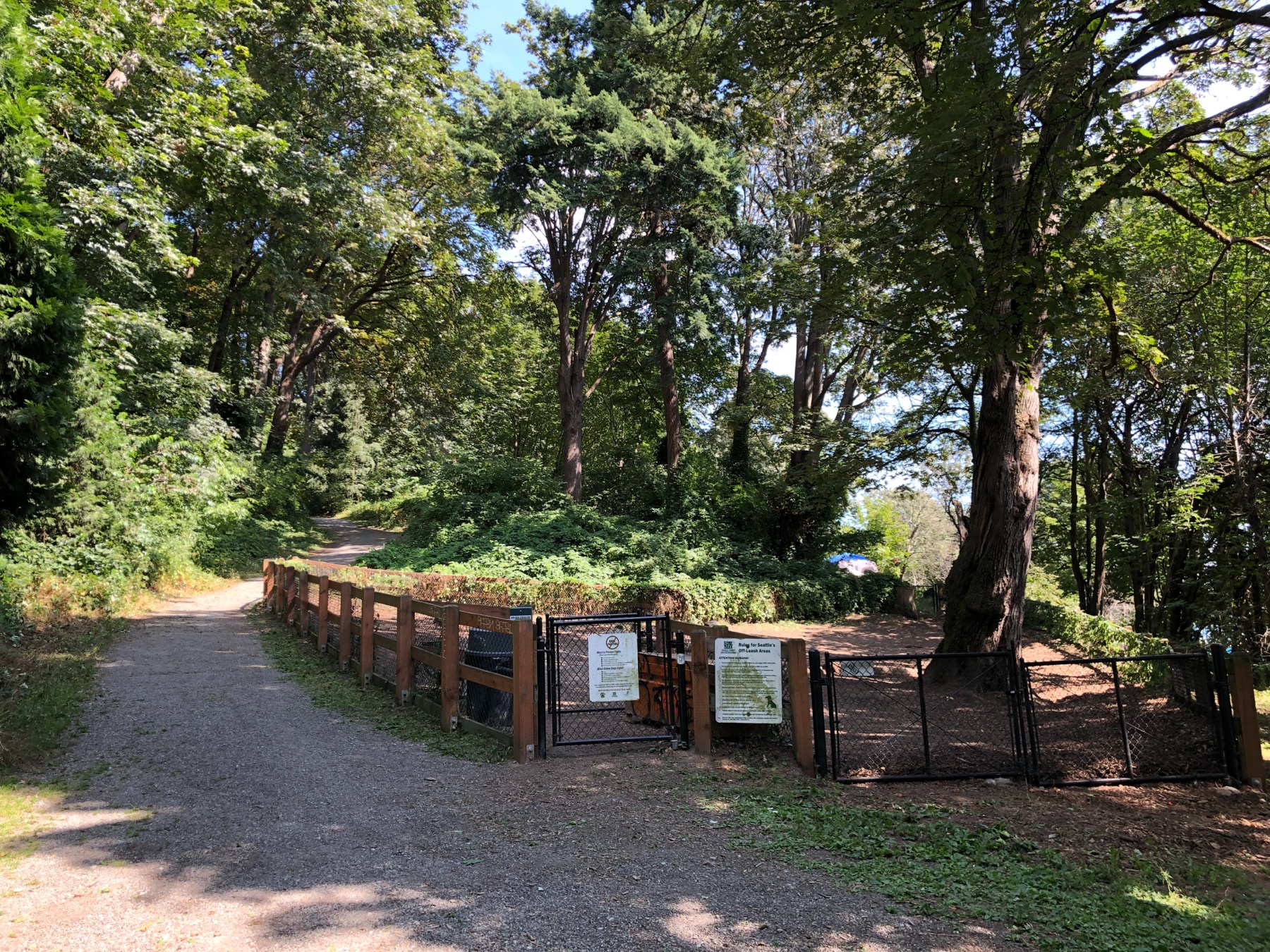
Queen Anne's only nearby OLA is Seattle's smallest at 0.124 acres. Located at the bottom of a hillside greenbelt on the southwest slope of Queen Anne Hill, it is the closest legal off-leash option for most of Queen Anne and large parts of Magnolia — an area home to tens of thousands of residents and an estimated several thousand licensed dogs (see the deficit chart above; ZIP-level counts in scripts/analyze_pet_licenses.py).

0.124 ac
Fenced area
20+ yrs
Incident record
Context

A small OLA with long-running site-adjacent issues.

Kinnear's OLA is at the far side of Lower Kinnear Park from the parking lot and main entrance. The park it sits in has been the site of documented homeless-encampment activity and clearance cycles for over 20 years. Contemporaneous reporting and city records are summarized below.

2000
Kinnear is not included in Seattle's $198 million Pro Parks Levy.
1999 & 2003
Beating deaths reported in Lower Kinnear. Quoted in 2007 Seattle Weekly feature: “Everyone in Queen Anne knows that lower Kinnear Park is just a place you don't go because it's not safe.”
2007
A new dog run is approved for Kinnear — the 12th in the city. Initial reporting notes two issues: no construction funding, and “the area just below where the dog run is supposed to be situated is currently occupied by regular encampments of the homeless.”
2008
City crews clear the Queen Anne greenbelt near Kinnear over multiple days, filling multiple garbage trucks. SPR spokesperson Dewey Potter to the Seattle Times: “We try to be as laissez-faire as we can. Because life is tough with these folks. We try to look the other way.”
2020
Dog-owner review notes the encampment along the access path: “You have to walk past it to get to the off-leash area and we didn't feel super safe doing so... I would recommend not going when it's dark and not going alone.”
2023
Investigative reporting identifies Kinnear as part of a “hidden encampment network” in Seattle's wooded parks.
April 2025
City clears a Kinnear encampment. Tents reappear within days. KOMO News: “It's unclear how many people were living in the park this time, but the garbage left behind is extensive.”
May 2025
Memorial Day cleanup: ~100 volunteers remove an estimated 10,000 lbs of trash from Kinnear and the adjacent greenbelt.

Implications for access counts. Kinnear is counted as Queen Anne's OLA in SPR's gap analysis. Observed usage patterns indicate that many Queen Anne dog owners drive to Magnuson or Magnolia Manor, or use Kerry Park, Rodgers Park, Queen Anne Bowl, or nearby school playfields (where off-leash use is not authorized). Plymouth Pillars (Capitol Hill), Denny Park (SLU), and Regrade (Belltown) sit in or adjacent to similar site-safety patterns. The nominal OLA count of 14 assumes all 14 are practically functional for their neighborhoods.

Finding 07Summary of the Part II findings.

The Part I, Part II, and Part III findings stack into a consistent profile:

Data notes

10-minute walkshed methodology. TPL defines the 10-minute walk as a half-mile service area along the public road network, cut by physical barriers (highways, tracks, rivers without bridges). TPL publishes the “99% of Seattle residents” figure using this methodology for all parks; TPL does not publish a dog-park-specific version. The OLA walkshed figures on this page (11.7% at 10-min, 76.6% at 2.5-mi) are computed in-repo: scripts/compute_walkshed.py runs osmnx against Seattle's OSM walk network (projected to UTM 10N; physical barriers respected) to compute per-OLA isochrones; scripts/population_coverage.py intersects the union with 2020 Census block-group population clipped to the Seattle city boundary. Each walk-area boundary is drawn as an alpha-shape (α=0.003) — a shape that hugs the reachable street network's actual concavities rather than bridging across them the way a simpler convex outline would — of reachable network nodes, with a 0.3 km² area floor and a convex-hull fallback for OLAs at the edge of OpenStreetMap (OSM) coverage (Westcrest is one). Output at data/walkshed/population_coverage.csv; full methodology in METHODOLOGY.md.

Peer-city OLA counts. The methodological differences are real and material. Portland's 38 DOLAs (TPL 2025) include 20+ unfenced voice-control areas; Seattle counts zero unfenced sites. Redefining Seattle's approach to include unfenced designated sites (as several other cities do) would raise its count, though SPR has publicly stated a preference for fenced sites on liability and environmental-impact grounds. The comparison in this report uses each city's TPL ParkScore count.

OLA acreage. Per-OLA acreage is pulled from SPR's Dog Off-Leash Areas ArcGIS FeatureServer (April 2026) and cross-checked against SPR individual OLA pages — see data/seattle-olas.csv. Peer-city totals are rougher (±20% reasonable) because no peer city publishes a single authoritative inventory in the way Seattle does.

Kinnear Park timeline. Drawn from contemporaneous reporting: Seattle Weekly (2007), Seattle Times (2008), Aussiedoodle Adventures (2020), Fix Homelessness (2023), KOMO News (2025). The 2008 Dewey Potter quote is verbatim from the Seattle Times piece.

“Dogs per OLA” calculation. Using the widely-cited 150,000 dog-population floor divided by 14 OLAs gives ~10,700 dogs per OLA; SPR's 2023 Expansion Study cites higher estimates (up to 400,000), which would raise the ratio to ~28,500.

Primary sources

TPL 2025 ParkScore Seattle PDF · TPL ParkServe methodology documentation · Seattle Parks & Recreation individual OLA pages · SPR Off-Leash Area Expansion Study recommendations (Parkways blog, Feb 2024) · SPR People, Dogs and Parks Strategic Plan (2017) · KOMO News on Kinnear (April & May 2025) · Seattle Weekly “Ruff Trade” (2007) · Seattle Times Queen Anne encampment clearing coverage (2008) · Queen Anne & Magnolia News OLA expansion coverage (Nov 2023) · Portland Parks & Recreation DOLA list · Sniffspot and BringFido (cross-referenced)

On framing. SPR foregrounds the city's overall park access, which is genuinely strong, and OLA investment has recently increased. TPL appropriately weights total park access more heavily than any single amenity. This report presents the specific slice of data that describes the off-leash system, computed on the same standards TPL and SPR use elsewhere. Related opinions and policy recommendations are kept on a separate opinion page.