
Seattle will not build its way out of this. It needs a policy change.
This is my take on what the data on this site shows, and what the city should do differently. This page is my opinion — everything else on the site is intended to be a factual reference.
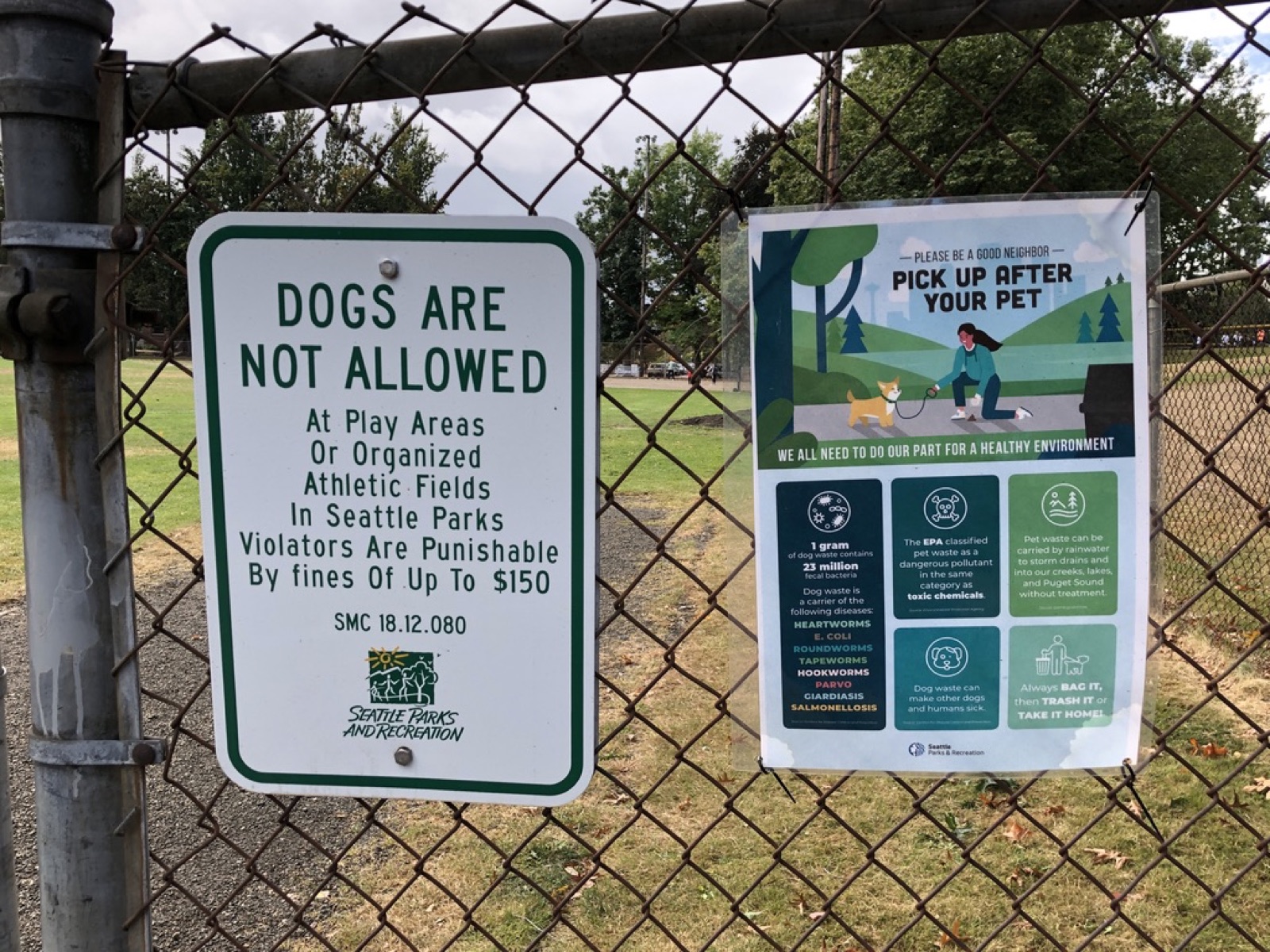
I'll be upfront — I own dogs, I walk them in Seattle's parks, I run them off-leash, and I have a strong opinion about how the city has managed off-leash access. The rest of this site is deliberately neutral. This page isn't. What follows is four principles I think most reasonable Seattle residents can get behind, three opinions that fall out of the data, the best arguments against me, and a recommendation I've been sharing with the city, council candidates, and SPR since 2014.
The broader argument: this is a hard problem.
This is a hard problem, with no clean answer that leaves everyone satisfied. Park space in a dense, land-scarce city is finite, and the people asking for more of it all have legitimate claims — dog owners, soccer leagues, community gardeners, neighbors who want a quiet lawn, kids who want a playground, runners, cyclists, birders. Several of them are right at the same time.
I have empathy for the council members, mayors, and SPR staff who've taken a run at this over the last two decades. They've held listening sessions, commissioned studies, drafted plans, spent years trying to site new dog parks — finally funding two more, now expected in 2027 and 2028, after a thirteen-year gap — and absorbed the complaints from everyone who didn't get what they wanted. Sit down with this in good faith and you run into the same walls every time — land, money, competing uses, neighborhood opposition. And any real change here upsets someone: more access for dogs feels like a loss to people who'd rather be in parks without them, and the status quo leaves 150,000+ dogs and their owners exactly where the rest of this site documents.
I don't have the perfect answer. But after twenty years of running the same playbook — study, listen, plan a park, repeat, with the first new off-leash areas (OLAs) since 2013 still not under construction — the data on this site shows the approach isn't closing the gap. It isn't even keeping pace. At some point, continuing to run a strategy that measurably isn't working becomes its own choice. The alternative I think is worth a real look is a time-zoned shared-use model, borrowed from cities that have run it for decades.
Part One: four principles
These aren't numbers — they're values plus factual observations. I think most reasonable Seattle residents, dog owners and non-owners alike, can sign on to them.
P1Seattle will never build its way out of the OLA shortage.
Zero net dog parks added since 2013 — thirteen years and counting — while the population grew 34% from 2010. The two funded sites won't open before 2027 and 2028. Even if SPR eventually builds every site on its current list, the per-capita gap to Portland, San Francisco, and Vancouver BC doesn't close. Seattle is physically constrained: dense, land-scarce, expensive parcels, already-extensive parks to maintain.
P2The little buildable land Seattle has should not go to dog parks first.
Seattle's in the middle of a long housing-affordability crisis and an ongoing homelessness emergency. When a rare parcel of city land comes loose, the case for housing, shelter, or services is stronger than the case for a new fenced dog park. I own dogs and I still believe this. Any serious plan to improve off-leash access has to start from the assumption that we're not getting more than a handful of small new OLAs over the coming decade — and that even a substantial funding increase would not be enough to close the gap. The land isn't there; no dollar figure conjures it into existence.
P3Seattle has more dogs than children, and the investment gap reflects that poorly.
Yes, kids should be prioritized over dogs. A city with 157 playgrounds and 14 dog parks is making a choice about who its parks are for, and on that axis the choice is right. A 1:1 split would be absurd.
The magnitude of the gap has gone past any reasonable prioritization. Even at the conservative 150,000 floor, dogs outnumber Seattle's ~115,000 under-18s — yet SPR runs 157 playgrounds against 14 fenced OLAs, the off-leash budget line has never reached half of one percent of SPR spending, and they occupy 0.46% of the city's parkland (the numbers). Prioritizing kids is right; arriving at a tenth of one percent of the budget, in the years before the current construction money, for a population the size of all dog owners is how we got here.
P4People who don't want to be around dogs have a right not to be. So do kids who want a clean field.
Non-negotiable. Every dog owner I respect accepts this. Kids who are afraid of dogs, adults who don't want a strange dog in their face, picnickers, joggers, people using the park for a dozen other reasons — none of them signed up to share space with an unfamiliar off-leash dog. A playfield with dog feces on it, or a baseball diamond where someone's loose dog just ran through left field, is a system failure on every axis. The current setup, where about 38% of dog owners self-report illegal off-leash use, fails these residents directly: non-owners have a city full of parks that are technically dog-free but in practice aren't, and dog owners have a few tiny, often-unsafe OLAs. Both groups lose. Whatever fix comes next has to give each use reliable time in the park, and protect non-dog use at least as well as the current system pretends to.
Part Two: three opinions that fall out of the data
O1The current rules have failed, and Seattle is doubling down on the part that isn't working.
In 2014 the Seattle City Council asked SPR to rethink off-leash policy. SPR spent over a year running surveys and in-person interviews with dog owners, parents, Citizens for Off-Leash Areas (COLA), and neighborhood groups. The consistent feedback was that the pre-2014 policy was unworkable, enforcement was structurally insufficient, and other cities had already tried shared-use or time-zoned models worth studying. The resulting People, Dogs and Parks Strategic Plan kept the same framework, added one full-time animal-control officer, and declined to pilot any shared-use approach. In the years since, the OLA count hasn't moved, and illegal off-leash use has if anything grown with the dog population.
The city's answer has been to expand enforcement. But more officers won't change behavior, because the binding constraint isn't headcount — it's authority. Animal Control Officers are not police: they can't compel identification or detain, so by Finance & Administrative Services' own 2022 report to Council, officers now “issue verbal warnings on all first contacts” (the documented detail). Deterrence is the product of two numbers — the probability of being cited and the size of the penalty — and in Seattle both sit near the floor. The probability is tiny (well under 1% per dog per year, and only 21 actual citations in all of 2024), and the penalty is capped: first offenses are $0 or $54, the practical ceiling is about $162, and pushing fines higher just turns them into a regressive access fee the wealthy absorb (O2). And no amount of patrol manufactures a legal place to run a dog where none exists.
It does cost real money, and since July 2026 we know how much. The Park District approved three officers in 2023, and SPR was billed for three from the start — $456,173 in 2024 alone, on invoices computed from a flat 40-hour week rather than from hours worked — while the Animal Shelter was telling SPR it could field one and a half to two officers. SPR's own manager reviewed the output in 2024 and recommended cutting the program. Leadership sent it back at three. The dollar amount matters less than where it goes: into a lever the city's own agency says doesn't move behavior (enforcement: funded, billed, deployed). Redirect that spend to a clean-park compliance model — time-zoned shared use plus post-session cleanup, per the recommendation below — and you'd put a far larger presence in parks at the moments they actually need it.
O2Fines will never work — not at any amount Seattle could plausibly adopt.
The numbers: 7,015 off-leash enforcement contacts between January 2014 and April 2026, of which 3,151 were actual citations, against a dog population of at least 150,000. At the city-wide average that's well under a 0.5% chance per dog per year of being cited, and falling. Treat that as a rough figure, not a statistic: owners who never off-leash have zero exposure, owners at high-patrol parks face more, owners where rangers don't patrol face close to zero. What the data does support: about 89% of contacts were first offenses at $0 or $54. Second offense is $109, third $136, fourth-plus $162. Even at the code's ceiling it gets absorbed by higher-income owners as a de-facto access fee, and raising it further hits a regressive-enforcement problem — the same $500 fine that's meaningful to a lower-income owner is a rounding error to a wealthy one. The fine-based model is structurally mismatched to the behavior.
O3Dog owners will keep running dogs off-leash under the current rules. For rational reasons.
People break the law here because the legal option is often worse. Nine in ten Seattle residents have no legal OLA within a 10-minute walk (walkshed analysis). Where one exists, it's often too small to use safely — seven of 14 are under one acre, three under a quarter-acre; Kinnear (0.124 acre) posts a sign asking anyone with more than three dogs to go elsewhere. Several sit in or next to areas with chronic safety concerns that make them effectively unusable, especially for women, after dark, or alone. It's a supply failure producing a compliance failure, and the city's own enforcement agency said as much to Council in 2022: “The lack of available Off Leash Areas could encourage pet owners to take their dogs off leash in regular City parks” (FAS, June 2022). No amount of enforcement addresses the underlying cause.
Part Three: the best arguments against me
These are pulled from a 147-comment April 2021 Nextdoor thread about Queen Anne Playfield where neighbors on both sides engaged substantively. Every argument here was made by a real neighbor, not a strawman. Where the counterargument is correct, I say so.
C1The objections I mostly agree with.
“Dogs are not allowed on this playfield. The rules are clear. Follow them.” Correct: SMC 18.12.080 is unambiguous and athletic playfields are dedicated to organized play. My argument isn't that individual rule-breaking is justified. It's that the rule has failed at the system level, and the fix is policy change. “Having a dog is a privilege, not a right. Don't expect public resources to subsidize that choice.” Agreed in the narrow sense, and the wrong frame for a policy question: SPR's own plan estimates 150,000 dogs in the city, roughly one for every four residents, and a city that allocated a tenth of one percent of its parks budget to a constituency that size, before the current round of construction money, has an allocation problem, not a rights problem. “The ratio of dogs to children isn't a basis for the OLA budget.” Correct; it's a scale indicator, not a prescription, and I'm not arguing that a quarter of the parks budget should go to OLAs. “There's no land, and if there were it should go to housing.” Yes, and yes — see P2, and the twenty years the Queen Anne Community Council's Parks Chair has spent watching sites at MacLean Park, David Rogers Park and Smith Cove get rejected. That's exactly why my recommendation isn't “build a lot more OLAs.” “Lobby for change. Don't break the law.” The first half is completely fair; a parent at softball practice didn't set SPR's OLA allocation. On the second: people have lobbied, for decades, and the city's answer has been to expand enforcement of a failing law. At some point “lobby harder” stops being a serious response.
C2“Off-leash dogs cause real harm to other park users. I've seen it.”
Confirmed — multiple times, by non-advocates, at the same park. In the thread referenced above, one neighbor documented a small off-leash dog running at an 8-year-old's feet at Big Howe. Another described a flag football game at Queen Anne Playfield being paused several times because a single off-leash dog kept running into play. A softball parent described her daughter's practice where “every practice the girls are stepping in dog poop.” These are real, and they strengthen the case for a structured shared-use model rather than weaken it. The current setup produces these incidents despite the law, because enforcement is structurally insufficient. A time-zoned model with dedicated cleanup staff directly addresses each of these by reserving prime athletic hours for athletic use and pairing the off-leash window with visible compliance staff.
C3“Fine, but don't fantasize that a shared-use pilot will actually be enforced any better than the current rule.”
Fair and concrete. If the city can't enforce “no dogs ever on athletic fields,” why would it enforce “no dogs on athletic fields from 9 AM to 9 PM”? Two answers. First, the shape of the rule is different — a time-bounded window is something an owner can plan around, which the current blanket rule isn't. Second, the recommendation redirects the enforcement budget away from citations and toward on-site compliance monitoring at the transition hours and post-session cleanup. You can't enforce every park every minute of every day. You can enforce a handful of designated parks at two specific transition points per day. That's tractable, and it's what New York has done for nearly twenty years.
Part Four: SPR's own access standard proves the point
SPR's 2017 People, Dogs and Parks Strategic Plan defends current OLA coverage with an access claim that, once you look at it, is the clearest evidence of the framework's failure: most Seattle residents live within 2.5 miles of an OLA. The Green Lake loop is 2.8 miles. SPR is effectively arguing that walking the Green Lake loop one-way to reach your dog park, and then walking it back, counts as reasonable access.
Trust for Public Land's industry-standard metric is 0.5 miles — the same 10-minute walk SPR happily cites when noting 99% of Seattleites live within a 10-minute walk of a park, and the standard NRPA, the Urban Land Institute, the National Park Service, and the CDC all use. SPR uses the tighter standard when celebrating its park system, and one 5× more permissive to paper over the OLA-specific failure. It goes further than that. SPR told the City Council in December 2021 and again in August 2022 that "among the top 12 park systems in the country, TPL ranks Seattle in the top 5 in terms of access to dog parks per capita." Thirteen days before the second presentation, SPR's own policy staffer asked the deck's author to "point me to the source of that info." The records SPR released in July 2026 contain no reply and no source, and the claim went to Council unchanged (PRR C266465). TPL's published figure puts Seattle at 1.82 dog parks per 100,000 residents, below every West Coast peer. The absence of a reply in a records release isn't proof none was sent. But when the department's access claims to Council are the thing under examination, that's the record.
Part Five: what Seattle should actually do
Given the principles and the evidence, the realistic path forward is to change the policy about how dogs and people share the parks Seattle already has, rather than keep building small fenced OLAs. The model is New York's, which has run time-zoned off-leash hours formally since 2007 and informally for far longer. What its record shows, and doesn't, is laid out on Part III.
A time-zoned shared-use policy for Seattle's parks.
Adopt a shared-use model similar to New York City's long-standing off-leash hours policy — early morning and evening windows in designated parks during which dogs may be off-leash under owner control, with the rest of the day reserved for traditional park use. Pair it with a different enforcement posture focused on shared-use compliance, not leash-law violations.
- Designate shared-use parks by neighborhood. Not every park participates. Parks with heavy children's programming — active playfields during league season, for instance — stay fully leashed 24/7. Parks that already show up in the enforcement data as places people off-leash anyway become eligible candidates.
- Time-zone the access. A model like NYC's — off-leash from park-opening to 9:00 AM and from 9:00 PM to park-closing — gives owners practical morning and evening windows and reserves prime daytime hours for general park use. Pilot it. Adjust the hours per park based on observed use.
- Pivot enforcement from fines to compliance. Redeploy SPR Animal Control and park rangers to monitor participating parks during off-leash hours — confirming owners are present, dogs are under control, and the park is left clean. That's a different job description from “drive 6,662 acres hoping to catch someone.”
- Add clean-park staffing — call it poop patrol. A dedicated crew does post-session sweeps of shared-use parks at the transition back to leashed hours. If a participating park is repeatedly found uncleaned, it can lose shared-use designation. That collective threat is the real enforcement mechanism — it gives every responsible owner at the park a stake in cleaning up after the minority who don't. Off-leash culture in practice runs on social pressure. Tickets and fines still apply to individual violators who get caught, but the enforcement that actually moves behavior is peer pressure plus a credible threat of losing shared-use status at the park level. A $54 ticket handed out hours after the fact by an officer who wasn't there doesn't change anyone's behavior.
- Fund it with expanded dog-license fees and redirected enforcement spend. Seattle's dog-licensing revenue is modest. A meaningful increase, dedicated to the Seattle Animal Shelter and this new clean-park program, is far more politically viable than a fines increase, and it avoids the regressive-enforcement problem.
- Keep the small dedicated OLAs. Kinnear, Plymouth Pillars, Magnuson, and the rest don't go away. They stay as all-day off-leash options for people who want them. They just stop being the entire answer to a city-wide demand they were never sized to handle.
- Measure and publish outcomes. Track citation counts, Find-It-Fix-It complaints, injury reports, and post-session cleanliness audits by park. If a pilot park is underperforming on non-dog-user experience, pull it. If it's working, expand. This is exactly what the City has never done for the program it runs now, and what NYC's record lacks. Seattle's evaluation could become the analysis that doesn't yet exist.
Part Six: what I'd ask of the City Council and the Mayor
This argument has been made to the city before. Many times. This is a request for one specific thing the Council, and the Council alone, can deliver.
The most recent city-commissioned effort to rethink this was the 2023–24 SPR Off-Leash Area Expansion Study, produced at the Council's request explicitly to re-examine the approach. Read its recommendations alongside the 2017 People, Dogs and Parks Strategic Plan and the two documents are the same proposal in different cover pages: identify a handful of additional OLA sites where geometry and funding permit, and increase enforcement against off-leash violations. That was the pre-2014 plan. It was the 2017 plan. It is the 2024 plan. It has measurably failed to close the gap at every iteration, and the City has never once measured whether the enforcement half works.
Before the next study begins, the Council should put on the record that the 2023–24 Expansion Study returned an almost identical plan to the 2017 strategic plan, that the plan has measurably failed to close the gap at both junctures, and that returning a third time with the same framework is not an acceptable deliverable.
The charge to SPR — or to whichever body runs the next study — should explicitly require the production of at least one genuine alternative for Council consideration. A shared-use time-zoned pilot is one such idea. It's not the only one. Residents, peer cities, and practitioners outside SPR will have their own proposals if invited to offer them. Which specific alternative lands on the table matters less than that at least one does. A third round built on the same two levers — build a few more OLAs, fine the off-leash violators — is not an acceptable deliverable. Either or both might be components of a larger plan. Neither can be the core of it.
The Council has the standing here that individual advocates and SPR itself don't. SPR works with the mandate it's given. If the mandate keeps asking for a version of the same answer, it will keep getting a version of the same answer. Making “same plan, different cover page” an unacceptable outcome is the one thing only the Council can do.
Acknowledgments: the people who have been trying
This page argues that Seattle has failed at the OLA question. It hasn't failed because nobody tried. A few of the people who have, by name.
Queen Anne Community Council Parks Committee — two-plus decades of organized volunteer advocacy on Queen Anne parks, including the hilltop OLA question. Don Harper, who chairs the committee, has been the most visible single voice on it. QACC secured the 2008 levy funding that ultimately produced Kinnear and Magnolia Manor, and has attempted sites at MacLean Park, David Rogers Park and Smith Cove. Still at it.
Citizens for Off-Leash Areas (COLA) — the 501(c)(3) that has organized volunteer advocates, maintained OLA surveys and inventory data, and participated in every major SPR planning process since the 1990s. Every advocate who comes to this issue fresh builds on their work.
Magnuson Off Leash Group (MOLG) — for twenty-plus years, MOLG's volunteer stewardship made Magnuson the functional model of what a neighborhood-governed OLA can be. The group's public presence has since gone dark, but the recommendation on this page borrows explicitly from the model it built.
Seattle Parks and Recreation staff — this page is critical of SPR's policy choices, and SPR has been asked to do an impossible job in one of the densest, most land-constrained cities in the country, balancing kids, leagues, dog owners, wildlife, and a housing emergency on every square foot. The 2014–2017 process was sincere and the staff who ran it worked hard. My criticism is narrower: the resulting plan repeated the pre-2014 framework rather than piloting an alternative, and it's being repeated again. SPR is the right partner to run the pilot that tries something else.
Elected officials who've engaged substantively — then-candidate and later Councilmember Andrew Lewis (District 7, 2019–2023) was the most visible elected voice on this issue during his term. If you're a current council member or staffer, the records-request directory is the list of questions we're asking SPR.
Dog owners who have changed their behavior, and park users who haven't given up — every owner who drives out of their way to a real OLA, every parent who keeps bringing their kid to the playfield anyway, every coach still running practice. The status quo is a tax everyone pays, and it doesn't have to stay that way.
Notes on this page
This page is opinion. The principles, opinions, and recommendation above are mine. The data claims underneath them link back to the factual pages on this site, to public records, or to published primary sources.
Relationship to the 2014–2017 SPR process. I participated in the People, Dogs and Parks Strategic Plan live interviews as a community member. I'm not and have never been an SPR employee, a COLA board member, or an elected official. My views are personal.
On the “more dogs than children” figure. The 150,000-dog floor used throughout this site is conservative. Part I's methodology note walks through three independent estimates — a Seattle Open Data licensed floor (~26,700 active licenses), an AVMA-derived demographic estimate (~249,000), and the SPR 2023 Expansion Study range (187,000–400,000). The 150,000 floor sits below all of them by design.